HP TouchPad Run Android 4.0 Now

Posted by Unknown Sabtu, 10 Desember 2011 0 komentar
After HP announced that it had gave Touchpad up, and never produced again in this summer, this tablet reduced the price to only $99 to sold off the remaining stock. I believe that some of the customers want to switch this tablet to a cheap Android device.  So with many difficult solved, about one month ago, hackers had run CyanogenMod 7 on Touchpad successfully with audio and Wi-Fi still cannot work.

And now, developers have made a breakthrough to port the Android 4: Ice Cream Sandwich to TouchPad tablet. One team member has posted a photo of Ice Cream Sandwich running on his devices to prove that.  This post is already generation excitement and interest on the forums although it shows that the last version of Android 4.0 for TouchPad still not so stable. Sooner the community provided a patch for making touch input work on tablet. And this community claimed that the next priorities for the firm will include WI-FI and Android Market support.

While developers scramble to fix the bugs in the TouchPad Android firmware, however, yesterday’s announcement by HP that it would be open sourcing its WebOS software has led to a surprise reverse phenomenon of developers now hoping to port the operating system to Android devices.  But right now, most developers prefer to build Android apps.

Baca Selengkapnya ....

Android users can detect Carrier IQ

Posted by Unknown Rabu, 07 Desember 2011 0 komentar
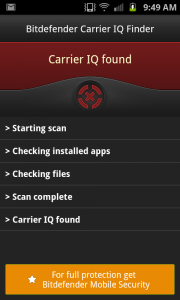
Most of mobile phone users want to detect whether Carrier IQ exists on their smartphones or not with the help you applications. For Android, most of the apps in Market cannot stop Carrier IQ from running, but at least some of them can detect and make sure whether the mobile phone is tracked or not.

Carrier IQ, as a process that can stealthily monitor users’ smartphone activity, had aroused the fierce controversy in the past few weeks.  Some see it as a serious threat to users' security and privacy, while others have likened the reaction to mass hysteria generated by the media.

After I searched with Google, I heard that BetaNews had tested out two of the available options to detect the Carrier IQ. One is BitDeferder’s Carrier IQ Finder, and the other one is Lookout Lab’s Carrier IQ Detector. The tests were performed on a Samsung Galaxy S II Skyrocket running Android 2.3.6 on AT&T's network, and both found Carrier IQ present but didn't indicate whether or not it was active.

They also spotted a few apps that claim to freeze the process that runs Carrier IQ's hidden application. These include Trey Holland's Bloat/CIQ Freezer Free and RDMSoft's Carrier IQ Process Killer. Without more extensive tests, they can't independently verify these actually work as advertised, but customer reviews are generally positive.

Baca Selengkapnya ....

Google Celebrates 10 Billion Android Downloads

Posted by Unknown Selasa, 06 Desember 2011 0 komentar
Google is closing the “app gap” in the smartphone market, at least when it comes to downloads. The company announced on Tuesday that Android users have downloaded some 10 billion apps to date on the Android Market, and that its monthly download rate has crossed the 1 billion mark.

As you can see in the chart above, those download numbers have been increasing at a brisk rate over the last 18 months or so as sales of Android devices have exploded around the world.

The numbers show that the Android ecosystem is healthy, but with any set of numbers, it’s easy to make of them what you will. For instance, Apple has been at a billion downloads per month for some time, but there are more Android devices in use now than there are iPhones.


That shows that Android users are downloading fewer apps per user than Apple’s iPhone customers, which suggests (to us) there are aspects of finding apps on Apple’s App Store or actually using them on Apple’s iPhones that are better than Google’s Android ecosystem.

At the same time, Android lags far, far behind in paid apps. In November, Piper Jaffray’s Gene Munster found that Apple’s App Store generated some twelve times more revenue than the Android Market. At that time, his research showed that 1.3% of Android downloads were paid apps, while 13.5% of iOS apps were paid.

Still, the law of numbers is inexorable. As Android gains more smartphone market share—currently at the expense of everyone but Apple—even that smaller percentage of paid apps will add up, giving more developers more reason to make more apps.

To encourage Android device owners to get used to the idea of paying for their apps, Google is offering a ten day promotion for ten cent (US$0.10) paid apps, starting with the following: Asphalt 6 HD, Color & Draw for Kids, Endomondo Sports Tracker Pro, Fieldrunners HD, Great Little War Game, Minecraft, Paper Camera, Sketchbook Mobile, Soundhound Infinity and SwiftKey X.

The company said that it will offer a new bunch of apps every day at the price during the course of the ten day promotion, which starts today. If you have an Android device, get ‘em while they’re hot and cheap.

We should also point out that these downloads don’t count the apps sold at Amazon’s Appstore for Android or the myriad of other services that offer Android apps. That means that the total worldwide download numbers for Android are higher than the subset represented by Google’s own Android Market, though Android Market certainly represents the lion’s share of that total.

Source is
http://www.macobserver.com/tmo/article/google_celebrates_10_billion_android_downloads/

Baca Selengkapnya ....

Most Android Devices Now Running Gingerbread

Posted by Unknown Senin, 05 Desember 2011 0 komentar
Google has released more than 6 versions of the Android operation system for portable devices. But the main Android-based devices are running one of the more recent version of the OS — Gingerbread.

Android 2.2 Froyo is still on 35.3% of Android phones as there are 50.6 percent of Android devices are running version 2.3, Gingerbread, the majority of which are on Android 2.3.3 or higher, according to stats posted on Google's developer site.

That's a switch from October, however, when 45.3 percent of Android devices were running Froyo and 38.2 percent were running Gingerbread.

About 9.6 percent of Android devices are running Android 2.1 Eclair, 1.3 percent have Android 1.6 Donut, and 0.8 percent have the first iteration of the mobile platform, Android 1.5 Cupcake.

Android 3.0 Honeycomb, an OS which designed for tablets which is intended only for tablets, has about 2.4 percent of the Android market, with most (1.2 percent) on Android 3.2.

The most-recent version of the OS, Android 4.0 Ice Cream Sandwich, has come out with Galaxy Nexus. Google had released the open source for Android 4.0 in Nov. 2011. We believe that ICS will also take a place in various mobile operation platforms.


Baca Selengkapnya ....

Android in 2012: What’s Next

Posted by Unknown Minggu, 04 Desember 2011 0 komentar

Google only scratched the surface with the latest improvements to its Android mobile operating system. Users have been left wanting more, and they are likely to get it in 2012.

Better graphics, better cameras, and maybe even a voice-command feature similar to Siri--bundled with the latest iteration of Apple's iOS operating system--could be on the horizon for Internet search leader Google.
Android's latest big update, Android 4.0, also known as Ice Cream Sandwich, is coming with the Samsung Galaxy Nexus, and it's only a matter of time before other smartphones and tablets begin seeing the update.

But even as fresh as Ice Cream Sandwich is, users are looking ahead. Android is already installed on tons of smartphones across countless wireless carriers, and that reach is sure to expand with each new update.

Doing More With Voice
Siri brought voice commands to the masses, and you can bet that Google is working on something similar for Android.

Ice Cream Sandwich already allows for instant speech to text, and voice commands have been a part of the OS since Android 2.0, but they lack some of the personal charms that Apple has given its voice-activated virtual assistant.

While we shouldn't expect a snarky secretary like Siri, we can look forward to Google incorporating voice functions into more of its apps. A great example of this is the new Google Translate app. It has a conversation mode that allows you to translate your speech and the speech of others into one of more than 50 different languages. It's by no means perfect, but it gives us a good idea of how Google can use voice input to make even better apps.

Better Camera Software
When it came to mobile cameras, the stock Android camera software was hardly something to brag about. It was clunky, slow, and had only a few basic settings you could really customize.

Ice Cream Sandwich gave the software a much-needed update, introducing features like panoramic photos and zero lag between snapshots. Future Android updates could include face detection and more-advanced settings for experienced shutterbugs. But those camera improvements wouldn’t just be for phones. Tablets that use video chat would gain better focus and video quality, especially as we begin to see more tablets that run over 4G and LTE networks.

More Apps That Take Advantage of Hardware Acceleration
We've recently seen more phones with dual-core processors, but unfortunately not all apps have been optimized to take advantage of the extra processing power. Starting with Ice Cream Sandwich, however, hardware acceleration is enabled by default, meaning that new apps released on the OS will run smoother and games will look better than their predecessors. Older apps will have to be updated to see a boost in performance, and how an app behaves on a dual-core versus a single-core device will be noticeably different.

More Devices

Android is a versatile OS, and it's been installed on everything from USB drives to robotic bartenders.

At Google I/O 2011 (an annual developer conference), Google launched the Android@Home project, a framework for Android to be installed into automated "smart" houses. These Android smart houses would communicate with other Android-powered gadgets to make life easier for the people inside.

Some car manufacturers are even looking into Android to power the media consoles in their vehicles and to do things like media sharing from phones to the car. If it has a chip in it, chances are someone will try to install Android into it.

Lighter Overlays
Android overlays are no big deal as long as they don't get in the way of the Android experience.

Overlays can add a lot of functionality--such as what we saw on Honeycomb tablets--but on phones, most of them are clunky and resource-heavy. With Ice Cream Sandwich incorporating a ton of useful features that were previously seen only on HTC and Samsung devices, overlays are slowly being toned down.

A good example: Motorola's MotoBlur overlay. Once an overwhelming and visually assaulting UI, the MotoBlur overlay has been greatly reduced to a lightweight skin that blends in relatively well with the stock Android UI.

A More Complete Shopping Experience

When it comes to media, iOS is the reigning king.
The iTunes store has not only apps and music, but also movies, TV shows, and even books. With the launch of Google Music, Google is trying to create a similar ecosystem for Android.

The Android Market is steadily becoming the one-stop shop for all Android-related media. You can currently rent movies from the Android Market, and it wouldn’t be surprising to see TV shows and podcasts also make their way to the Google-run store. Once Google adds those to its Android Market lineup, Android will become a much stronger contender in the mobile media-player space.

Next: Jelly Bean?

Expect at least two updates to Android in 2012.

One will most likely be an incremental update to Android 4.0, but some observers expect another major update to the Android OS as well. Reportedly named "Jelly Bean," some people are already calling this next iteration of Android a "game changer."

While details so far are slim, it is quite likely that Jelly Bean will contain one or more of the features described here.

Source is
http://www.pcworld.com/article/245072/android_in_2012_whats_next.html

Baca Selengkapnya ....

Your Android Phone Is Secretly Recording Everything You Do

Posted by Unknown Rabu, 30 November 2011 0 komentar
If you have any decently modern Android phone, everything you do is being recorded by hidden software lurking inside. It even circumvents web encryption and grabs everything—including your passwords and Google queries.

Worse: it's the handset manufacturers and the carriers who—in the name of "making your user experience better"—install this software without any way for you to opt-out. This video, recorded by 25-year-old Android developer Trevor Eckhart, shows how it works. This is bad. Really bad.

Update: Nokia wrote to us saying that Carrier IQ's spyware is not included in any of their cellphones.

Fast forward to 9:00 for the damning sequence.

The spying software is developed by a company called Carrier IQ. In their site, the company says they are "the only embedded analytics company to support millions of devices simultaneously, we give Wireless Carriers and Handset Manufacturers unprecedented insight into their customers' mobile experience."

Who has this problem?

It seems like a good goal and, indeed, most manufacturers and carriers agree: according to Eckhart, the spyware is included in most Android phones out there.

Eckhart claims that Carrier IQ software is also included in Blackberry and Nokia smartphones too. It probably works exactly the same in those smartphones as well. However, there's no proof showing these problems in those phones. There's no mention about Apple's iPhone.

It also doesn't even matter if your telephone was purchased free of carrier contracts. As Eckhart shows in this video, it's always there.

The problem is that it does a lot more than log anonymous generic data. It grabs everything.

How does it work?

Carrier IQ's software is installed in your phone at the deepest level. You don't know it's there. You are never warned this is happening. You can't opt-in and you certainly can't opt-out.

The commercial spyware sits between the user and the applications in the phone so, no matter how secure and private your apps are, the spyware intercepts anything you do. From your location to your web browsing addresses and passwords to the content of your text messages.

This even happens using a private Wi-Fi connection instead of the carrier 3G or 4G connection.

The company denied all this in a public statement (PDF):

    While we look at many aspects of a device's performance, we are counting and summarizing performance, not recording keystrokes or providing tracking tools

But the video clearly demonstrates that this is not true: Keystrokes submit unique key codes to Carrier IQ. Even secure connections are intercepted by the spyware, allowing it to record your moves in the open. These connections to the web are encrypted but, since Carrier IQ's spyware sits between the browser and the user, it grabs it and sends it in plain text.

The spyware can even log your location, even if the user declines to allow an app to know where it is. The hidden Carrier IQ app ignores your desires, intercepts the data and gets your location anyway.
What can you do to avoid it?

Unfortunately, not much. The hidden spyware is always running, and there's no option in any of the menus to deactivate it. Unless you're a grade-A blackbelt hacker, you're out of luck. Even Eckhart, who is a developer, finds it difficult to remove:

    Why is this not opt-in and why is it so hard to fully remove?

It's an excellent question. One that urgently needs an answer, from Carrier IQ but especially from every handset manufacturer and carrier involved in this situation.

The solution to this problem is not installing a custom ROM. That's something that shouldn't be required from consumers, something that normal people will not be willing to do. Products must respect privacy rights out of the box. Consumers must be informed about this the moment they turn on their phones in a clear way. They should have the possibility to opt-in and opt-out whenever they want, with a single click. This matter should be solved now by Carrier IQ, the handset manufacturer and the carriers.

If it isn't solved as soon as possible, authorities in the US and Europe should nail them with everything they have.

Source is
http://gizmodo.com/5863849/your-android-phone-is-secretly-recording-everything-you-do

Baca Selengkapnya ....

Meet Cluzee, Android's next Siri alternative

Posted by Unknown 0 komentar
Cluzee is the latest attempt to replicate the Siri experience on Android.
Android users looking to replicate the Siri experience have another option now, with the introduction of an app called Cluzee.

Developed by startup Tronton and touted as a "talking intelligent personal digital assistant," Cluzee attempts to step up where other alternatives fall short. The free app is available now for devices running Android 2.1 or higher and has already gotten attention in the tech community.

As you'll see in the video below, Cluzee is designed to answer simple questions with real, helpful responses. Need to find a nearby pizza joint or check the weather forecast for the next few days? Cluzee is the app to handle not only these requests but many other tasks as well. The app also reads e-mails and text messages aloud, converts voice to text, and even searches for deals that fall in line with your buying habits.


I've spent some time with Cluzee and already appreciate the application for what it does and how it handles commands. However, I've also seen some of its limitations and can see plenty of opportunity for future updates.

For example, I told Cluzee, "Remind me to call Mom tomorrow at 1 o'clock." The app recognized my request down to the word, but I still had to pick the time and adjust the date before confirming it on my calendar. In another instance, when I tried booking a hotel in San Francisco for June 25, 2012, the app merely opened a page for me to manually enter data. Commands to "Find hotels" or "Locate hotels" yielded a similar response.

Where I find Cluzee to be a fun and useful application is in its ability to find deals based on location. Powered by Groupon and Yipit, Cluzee found a number of savings on products and services in my area. What's more, I enjoyed being able to log my food eaten and track meals and calories and even set goals.

Also, dictating a Twitter update or Facebook status message is relatively easy and intuitive, though it still feels like there might be a step or two to eliminate along the way.

In terms of Siri counterparts for Android, Cluzee can already be considered one of the best options available. Sure, it has a ways to go before it can really match up against the iPhone 4S' killer feature, but it is a decent version 1.0 offering. The app's colors and layout are nice and the welcome screen recalls Vlingo's early splash screens with a list of commands and options.

If there were one feature I would add to the next release, it would be a simple widget button that I could add to my home screen. It doesn't make much sense to open the app just to push another button. Call me lazy or spoiled, but I expected to be one tap away from adding appointments to my calendar.

For all the things Cluzee is designed to do, it handles some of them very well. It simply takes a bit of experimenting to figure out what you can and cannot ask the app to do for you.

Source is
http://reviews.cnet.com/8301-19736_7-57333267-251/meet-cluzee-androids-next-siri-alternative/

Baca Selengkapnya ....
Trik SEO Terbaru support Online Shop Baju Wanita - Original design by Bamz | Copyright of jelly bean tablet.